
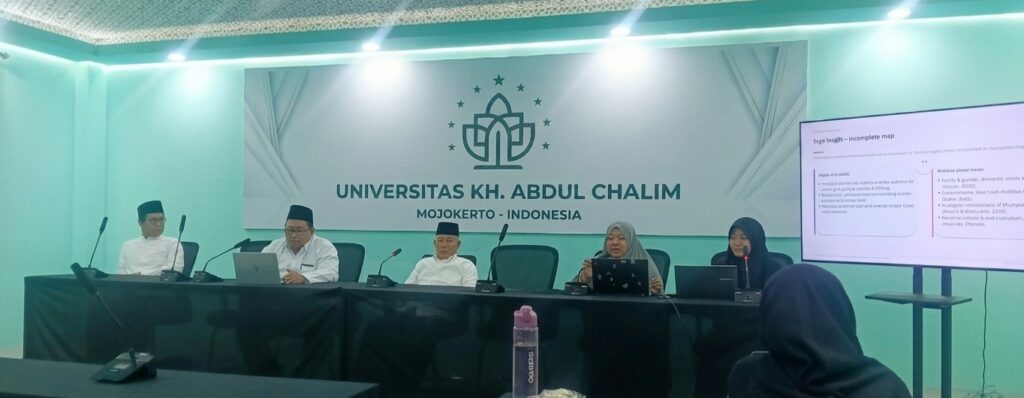
Mojokerto, Bidik – The Arabic-English Language Consortium (AELC) of Universitas KH Abdul Chalim (UAC) launched its series of weekly academic forums on Friday, 14 August 2026, at the Examination and Meeting Room, Postgraduate Building, Universitas KH Abdul Chalim. The forum is scheduled to be held every Friday as a regular platform for academic discussion, knowledge exchange, and intellectual engagement among members of the university community.
The AELC was initiated by Prof. Dr KH Asep Saifuddin Chalim, M.A., the founder and patron of Yayasan Pendidikan dan Pesantren Amanatul Ummah Mojokerto. The establishment of the consortium reflects a commitment to strengthening academic interaction and creating a sustained space for scholarly exchange within the university community.
The inaugural session featured Prof. Dr Fadly Usman as the speaker and Dr Nurul Azizah Ria Kusrini as the discussant. The session brought together two perspectives on Islamic education, community engagement, and inclusion. While Prof. Fadly focused on practical approaches to engaging marginalized communities through Islamic education, Dr Nurul examined community-based Islamic education through the case of Jama’ah Tabligh and considered its opportunities and challenges from several multidisciplinary perspectives.
Islamic Education for Marginalized Communities
Prof. Dr Fadly Usman presented a topic entitled Islamic Education for Marginal Communities: Building Strong Relationships with Marginal Communities. His presentation emphasized the importance of community engagement as an active process in which communities participate in the planning, implementation, and evaluation of initiatives that affect them.
The presentation highlighted several potential approaches to strengthening Islamic education and community relationships. These included education and training programs, social activities and volunteering, partnerships with local organizations, innovation and sustainable development, and partnerships with marginalized communities through Islamic education programs.
Particular attention was given to the possibility of involving local communities in Islamic educational activities centered around nearby mosques. Such engagement was presented as a way of strengthening relationships with marginalized communities while supporting deeper understanding and practice of Islam in everyday life.
Prof. Fadly also emphasized the importance of evaluating community engagement. Suggested indicators included increased participation, positive changes within the community, feedback from participants and partners, and the success of Islamic education programs conducted through mosques.
A Critical Perspective on Community-Based Islamic Education
The forum was followed by a presentation from Dr Nurul Azizah Ria Kusrini, who explored Inclusive Islamic Education Through Jama’ah Tabligh: A Comparative Reading of Widodo et al. (2026) through Multidisciplinary Lenses. Her presentation approached inclusive Islamic education from a different perspective, examining Jama’ah Tabligh as a form of community-based Islamic education.
Dr Nurul’s discussion highlighted several dimensions of community-based Islamic education. These included accessibility and participation, family and gender considerations, emotional dimensions of religious learning, theological perspectives, social reception, and curriculum depth. The presentation highlighted how community-based learning can reduce barriers to participation while also raising questions about the broader social and educational implications of such practices.
Among the issues examined was the role of emotional processes in religious learning. Drawing on the literature discussed in the presentation, Dr Nurul described a sequence involving self-reflection, concern, hope, reward, and a sense of entrusted moral purpose. These dimensions illustrate how religious education can involve not only the transmission of knowledge but also the development of emotions, motivation, and moral identity.
The presentation also considered social reception and curriculum. Jama’ah Tabligh’s educational practices were discussed in relation to varying levels of acceptance, social prejudice, adaptation, and questions concerning the balance between accessibility and curricular depth.
Bringing Different Perspectives into Academic Dialogue
Although the two presentations approached the subject from different directions, both highlighted the importance of understanding Islamic education within its wider social and community context. Prof. Fadly’s presentation emphasized practical community engagement and the development of educational programs for marginalized communities, while Dr Nurul’s presentation offered a critical examination of community-based Islamic education through a specific religious movement and a range of multidisciplinary perspectives.
Together, the presentations broadened the discussion of how Islamic education can engage with communities, particularly groups that may experience barriers to participation. The forum, therefore, provided participants with an opportunity to consider both the practical dimensions of community engagement and the complexities that accompany community-based educational practices.
Strengthening Academic Exchange through AELC
The AELC Academic Forum demonstrated the value of bringing together different academic perspectives within a shared area of interest. Rather than limiting discussion to a single approach, the forum encouraged participants to consider Islamic education from practical, social, educational, and critical perspectives.
Through forums such as this, AELC continues to provide a space for academic exchange, reflection, and discussion among members of the university community. The event also highlighted the importance of connecting academic ideas with the realities and needs of communities, particularly in efforts to develop more inclusive and meaningful approaches to Islamic education.